
How Our Clean Water Projects Work From Community Request to Sustainable Impact
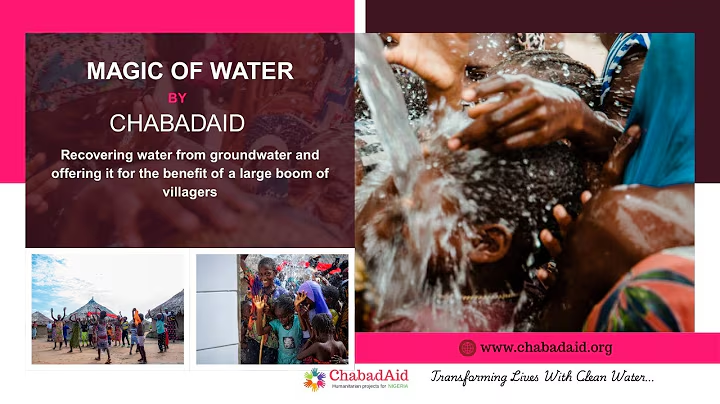
How Our Clean Water Projects Work From Community Request to Sustainable Impact
How Our Clean Water Projects Work From Community Request to Sustainable Impact
This video presents the full process behind our clean water initiatives in Nigeria—illustrating how each borehole project moves from initial community request to long-term, sustainable water access. Every project begins with listening. We first identify communities in urgent need by receiving requests and conducting on-site assessments. Population studies are carried out to evaluate the number of beneficiaries and the level of water scarcity.
Once a site is selected, professional geological audits are conducted to determine whether water is present underground, where it is most abundant, and at what depth it can be reliably accessed. Following this assessment phase, specialized drilling companies are mobilized. Heavy equipment—including drilling trucks, generators, and industrial machinery—is transported to the site. The drilling process then begins, penetrating deep into the ground until reaching the water table.
In the Abuja region, boreholes typically reach depths of 100 to 120 meters to ensure year-round access to water. Whenever possible, drilling aims to secure access to multiple deep aquifers, increasing sustainability and reliability. Once water is successfully accessed, a permanent water distribution center is constructed. This infrastructure allows community members to collect water freely, continuously, and in abundant supply—without limitation.
Although water access is provided free of charge, the village community assumes responsibility for maintaining the electricity supply required to power the water pumps. This is generally managed through the use of generators, ensuring continuous operation and local ownership of the project. This structured process guarantees that every clean water initiative is not only impactful—but sustainable, technically sound, and community-supported.
■ Watch the full process video here: